Documentation Index
Fetch the complete documentation index at: https://docs.zgi.cn/llms.txt
Use this file to discover all available pages before exploring further.
Design concept
ZGI is not a simple stack of functions, but revolves around a core goal: to make AI “usable, manageable, and retainable” in the enterprise. For this reason, we divided the entire product into four layers. Each layer corresponds to a type of real demands for enterprises to implement AI: from autonomous control of the underlying code, to unified access to models, to data governance, to upper-layer application and permission control. Each layer can be used independently or together to form a complete system.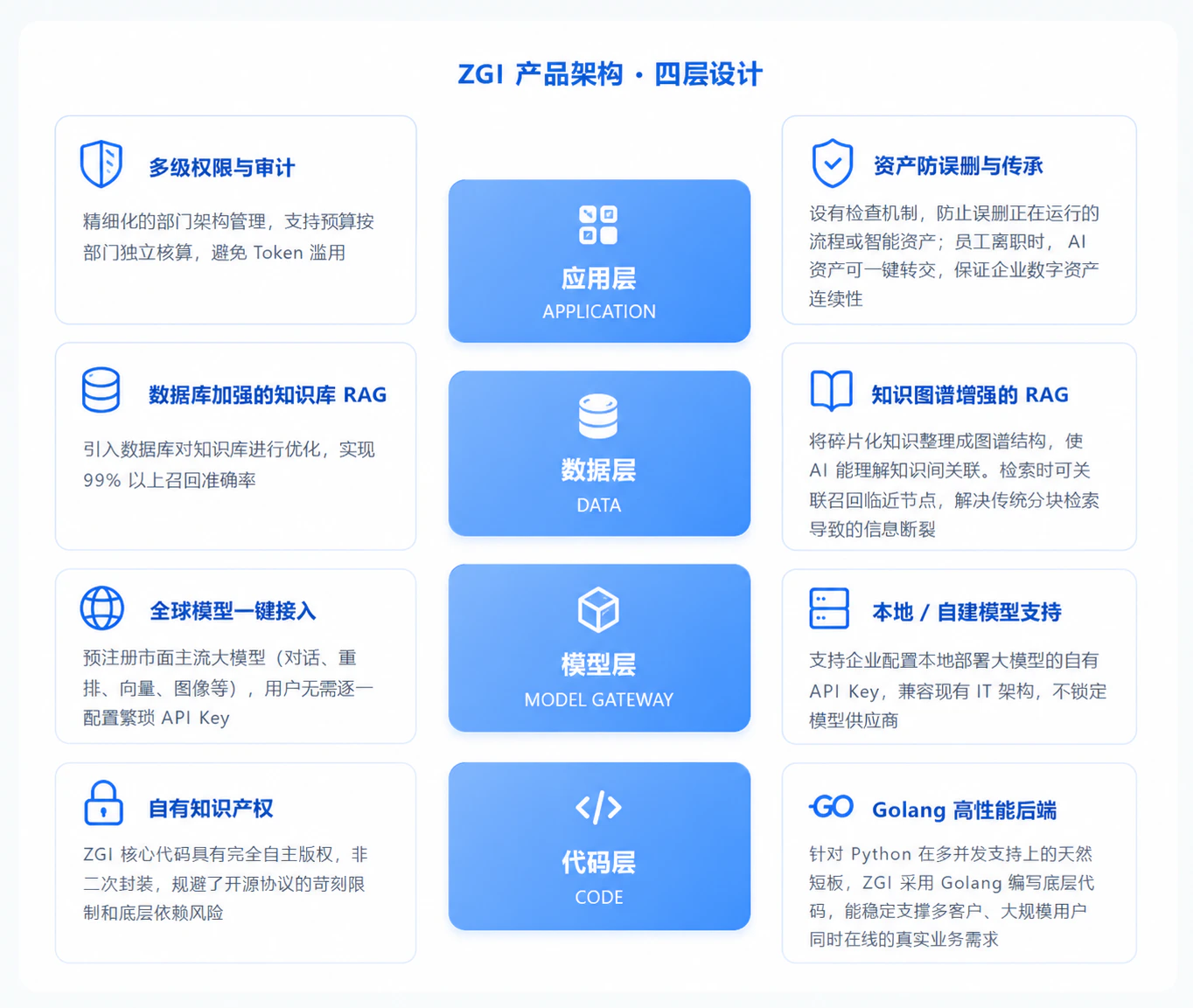
Responsibilities of each layer
1. Application layer—delivering AI capabilities to front-line businesses
This level provides directly available AI applications to enterprise end users and business teams: agent orchestration, Web console, mobile APP, enterprise permission management, agent operation monitoring, Agent templates, etc. Design focus: Assets belong to the enterprise, authority is controllable and auditable, and department budgets are independently accounted. These are not capabilities that are patched later, but are designed in from day one at the application layer.2. Data layer - allowing enterprise knowledge to be truly “used by AI”
The data layer contains two core modules: Knowledge Base (processing unstructured data, such as documents, contracts, FAQs) and Database (processing structured data, supporting NL2SQL natural language queries). Differentiation: Association modeling of fragmented knowledge through Knowledge Graph enables retrieval to no longer just focus on “text similarity”, but to understand the “relationship between entities”, solving the shortcomings of traditional RAG in cross-document association issues.3. Model layer — a gateway that unifies all models
The model gateway unifies different model suppliers (OpenAI, Anthropic, Google, domestic model service providers, and enterprise-owned models) into the same governance system: supplier management, channel routing, connectivity testing, call billing, and API Key control. Differentiation: Official channels and private channels coexist, which can not only use the platform’s preset capabilities out of the box, but also access the company’s own API Key, flexibly adapting to different cost and compliance requirements.4. Code layer - autonomous and controllable high-performance base
The bottom layer uses Go 1.24 + Gin framework + PostgreSQL 16, which is deeply optimized for enterprise-level high-concurrency scenarios. The front-end is based on Next.js 16 + React 19 and provides a responsive console. Differentiation: The core code is completely independent and copyrighted, and is not based on secondary encapsulation of other open source projects, avoiding upstream protocol risks and underlying dependency lock-in.Typical deployment form
| Form | Suitable for scene | Features |
|---|---|---|
| Cloud SaaS | Quick verification, small and medium-sized teams | Sign up and use, pay according to usage, expand on demand |
| Docker Compose | Development environment, small-scale production | One-click startup of the complete service stack, including database, cache, and vector library |
| Kubernetes | Production high availability | Helm Chart deployment, supporting elastic scaling |
| Privatized Enterprise Edition | Finance, government affairs, medical compliance | Data does not leave the intranet at all, supports local large models, and complies with SOC 2 / GDPR / Class III protection level |